

The article is in press on gurufocus.com (submitted April 19, 2026) . As soon as I'll have a sharable link, I'll put it here.
In the meantime here's the summary in three bullet points and a TL;DR in 9 points, plus an extract.
Summary
- Azimut has evolved into a high‑margin “global boutique,” growing AUM, earnings and dividends strongly over the past decade, but much of this progress is already reflected in a mid‑€30s share price.
- The business mix has shifted from volatile performance fees to more stable recurring fees (now accounting for around 90-95% of top-line), while net inflows and client exposure to private markets have surged, creating both higher fee potential and higher complexity/illiquidity risk.
- A SOTP and P/E‑based valuation suggests a fair value range broadly in the high‑€20s to mid‑€40s per share, implying Azimut is a reasonable income‑and‑growth play with moderate upside and non‑trivial risks, especially around lower‑margin international operations and private markets expansion.
TL;DR (9 points)
- Azimut has grown AUM from ~€60B (2019) to ~€141B (2025), revenues from €0.8B to €1.5B, and net income to ~€525M, with margins now ~47%.
- Dividends rose from €1.0 to €2.0 per share (2019–2025), a ~10% CAGR, with a 50–60% payout ratio that looks sustainable for an asset‑light model.
- The group has deliberately reduced performance‑fee dependence (24% of fees in 2021 to 4% in 2022), making >90–95% of revenues recurring but also signaling more muted relative fund performance.
- Weighted average performance (WAP) of AZM funds (+27.8% over 2019–2025) lags indices like MSCI World (+157% over the same period), though Azimut did protect capital relatively well in 2022 drawdowns.
- Net inflows have been very strong (~€94B over seven years), but 2025’s headline €32B includes ~€14B from acquisitions, so “organic” FY2025 inflows are closer to €18B (same as FY2024).
- Italy is still the economic engine, with ~1.9% fee margin on AUM and ~€545M EBIT, whereas international units earn ~0.9% on AUM and contribute more scale/diversification than profit so far.
- Private markets now represent ~8.6% of AZM client assets in Italy (vs. 0.5% in 2019), with a 15–20% target, boosting margins and stickiness but also illiquidity and valuation risk.
- A SOTP approach (higher multiple on Italy, lower on international, mid on alternatives) yields an EV range roughly €4.9–6.5B, or ~€34.5–€45.8 per share on 142M diluted outstanding shares.
- P/E scenarios (9x–12x on €430–€550M “normalised” earnings) give a similar fair‑value band (~€27–€46).
-
Extract from the in-press article:
[…] Why investors love private markets? We could debate for hours, yet Occam’s razor could be the “loss aversion” theory presented of above. Investors are humans, humans don’t like uncertainty. Public markets with daily quotations provide a lot of uncertainty with price swings. Private markets do not. Investors like that. Think why people love brick and mortar vs. public equity despite lower diversification and lower returns with higher maintenance costs.
Private markets also offered higher returns given the asymmetry of information frequently common in the space and the inherent earlier stage of the ventures, giving the company greater probability to show higher growth numbers in infancy vs. late-stage.
Practically, this has several implications. On the one hand it boosts average fee margins and “stickiness” of assets, as private funds are typically higher‑margin and (imposed as) longer‑duration products. On the other hand, it increases portfolio illiquidity and valuation complexity for end‑clients, particularly retail investors, which will ultimately hurt their confidence as in the notorious case in the US at the moment (“JPMorgan’s CEO warned of “cockroaches” in the private market).
Recent deals show that this strategy can be value‑accretive, but it adds an element of optionality and risk that is quite different from plain‑vanilla long‑only asset management in the public markets, even if it is beloved by the everyday-investor. […]
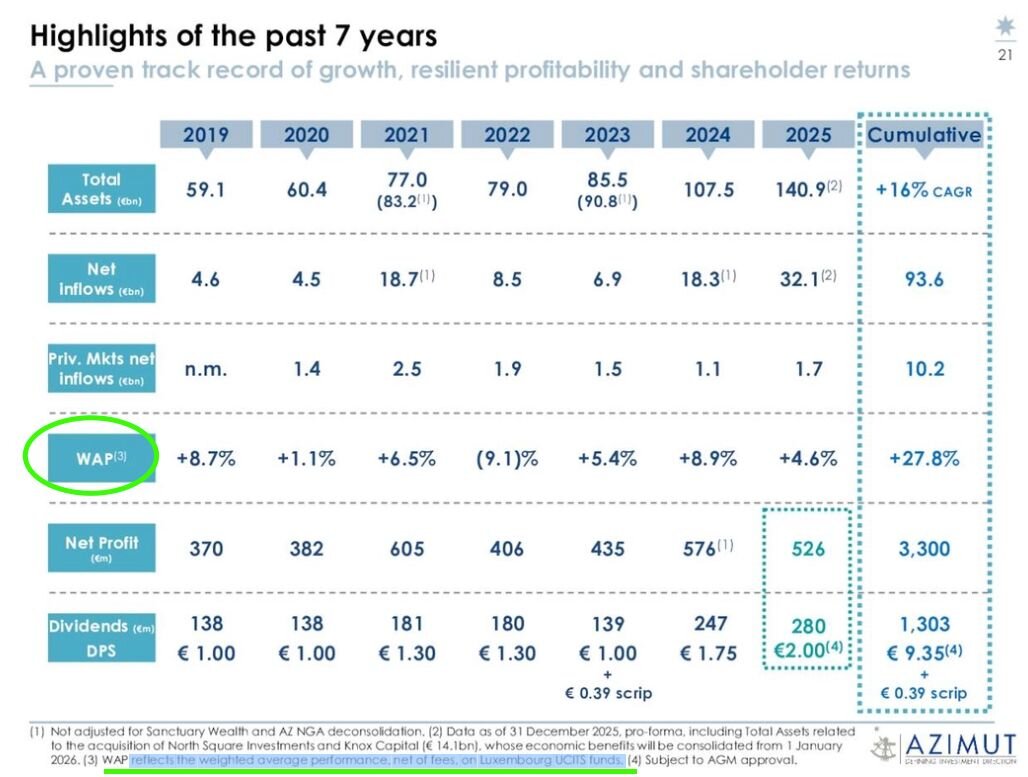
Source: official AZM FY2025 earnings presentation.
Disclaimer: I am not a financial advisor or registered investment advisor. The information contained in this article is for informational purposes only and should not be construed as financial advice. Past performance is not a guarantee of future results. You should always conduct your own research before making any investment decisions.
Disclosure: I/we may initiate a long position on AZM.


